
Relatives, we know that voting as an Indigenous person can be complicated. Long distances to polling stations, no guaranteed time off work to vote, confusing requirements for mailing addresses, and shifting ID laws work to intentionally suppress the votes of marginalized people (we plan to dive deeper into these systemic issues another time). As we gear up for the midterm elections in November, we think it’s important to begin discussing what Choctaw journalist B. ‘Toastie’ Oaster called the “Native Vote Dilemma” – that existential question of how we engage with the political system that colonized our land and continues functioning as a settler-colonial nation-state. At NDN Collective, we are committed to the liberation of Indigenous Peoples – which requires a multi-faceted approach to organized political power.
We must understand the politics of our community, and we must know what politics is supposed to produce. We must know what politics play in our lives.” – Malcolm X, 1964
The nuances around voting as Indigenous people cannot be summed up in a simple slogan. So instead, we are leaning into the complexities and contradictions of voting while Indigenous. We spoke with three colleagues at NDN Collective: Director of He Sapa Initiatives Dr. Valeriah Big Eagle, Director of Organizing Eva Cardenas, and Senior Domestic Policy Strategist Davis Price, to learn about their thoughts on voting.
What does voting represent to you personally as an Indigenous person?
Dr. Valeriah Big Eagle: For me, voting represents one tool among many for exercising our inherent sovereignty and ensuring our voices are heard. Indigenous people have always participated in systems of governance and collective decision-making. Voting is a way to protect our communities, but it is not the only way we create change.
Eva Cardenas: Oftentimes when I think about what voting represents to me, I revisit Malcom X’s speech in 1964, The Ballot or the Bullet. Throughout the speech, Brother Malcom articulates how we as a People can flex our power when it comes to governance. He reminds us of the responsibility we have to one another to fight as People seeking Liberation in all terrains, including the political one. He states, “We must understand the politics of our community, and we must know what politics is supposed to produce. We must know what politics play in our lives” – Malcolm X, 1964. He makes it clear that we must be committed to being conscientious of who speaks on our behalf in the political arena and pushes for the decolonization of ideals like assimilation, and take notice of the impacts it has on the People it claims to speak, decide, and collect through the political arena. Voting for me represents another opportunity for us to collectively make gains and exercise our collective Power.
Davis Price: Voting represents kuleana, which means responsibility and obligation in Hawaiian. This is responsibility to my ohana (family) and my community, not to the American political process. It also represents one tool of many to affect change in a system that fails us on so many levels.
How do you see the relationship between voting and organizing? How does one support or undermine the other?
Dr. Valeriah Big Eagle: Voting and organizing must work hand in hand to effectuate change. Organizing builds power, educates our communities, and keeps elected leaders accountable. Voting can help put people in positions where they can respond to those demands, but voting without organizing can become just a moment every few years, rather than part of a larger movement.
Eva Cardenas: Just like any other tactics we choose to engage within our work, there has to be a clear and intentional relationship between voting and a long-term organizing strategy towards a clear goal within a collective vision. As Malcom X states, we must be politically mature as a community and decolonize from the framework these institutions sell: one of blind obedience and allegiance, one of minimal participation and willful ignorance. One of autopilot. He reminds us that voting without clarity, knowledge, and active participation is detrimental. Voting without strategic plans and an aligned vision centering our People’s Liberation will not get us far.
Davis Price: Voting is just one tool in the toolbox for participating in the democratic process. I think organizing around issues that directly impact our communities is the most effective way to create change. Most issues that affect our communities as Indigenous people are tied to a public policy at some point, and that means there is an opportunity for elected officials to weigh in on those issues. Voting is one way to help influence the decisions those officials make. Elections are also a pathway to amplify our issues and our organizing efforts around those issues.
Indigenous people have always been invested in democracy; in fact, the US government structures are based on Indigenous democratic structures developed by the Haudenosaunee. What do you think the US structure gets right, and where did they go wrong?
Dr. Valeriah Big Eagle: The U.S. system recognizes some important principles of representation, collective decision-making, and checks on power. But it also failed to honor the sovereignty and political systems of Indigenous nations that existed long before the founding of America. The contradiction is that the U.S. drew inspiration from Indigenous democratic values while simultaneously dispossessing Indigenous people of their lands, rights, and governing authority. That is where the system went deeply wrong.
Eva Cardenas: I don’t believe the founders got anything right. The constitution they wrote was designed for people like them – white settlers who benefited from stolen land and stolen labor, all under a system held together by the fallacy of supremacy and justified violence. Just as they did with the land, they took concepts, ideals, and values from Indigenous People without actually intending to have a clear understanding of what a Democracy truly means. As the Kanasaraken Interview in The Mohawk Warrior Society, A Handbook on Sovereignty and Survival reminds us:
“The Iroquois Confederacy was the first one to deal with those settlers on a political level; we taught them how to govern themselves. They didn’t know how to be free, because they came from monarchies, but our people taught them. In teaching them, they put their government together; they taught them how to unite their thirteen colonies instead of keeping them separate. But they stayed monarchies in many ways, and they attacked our people instead of returning the favour.” – Kanasaraken, The Mohawk Warrior Society, A Handbook on Sovereignty and Survival
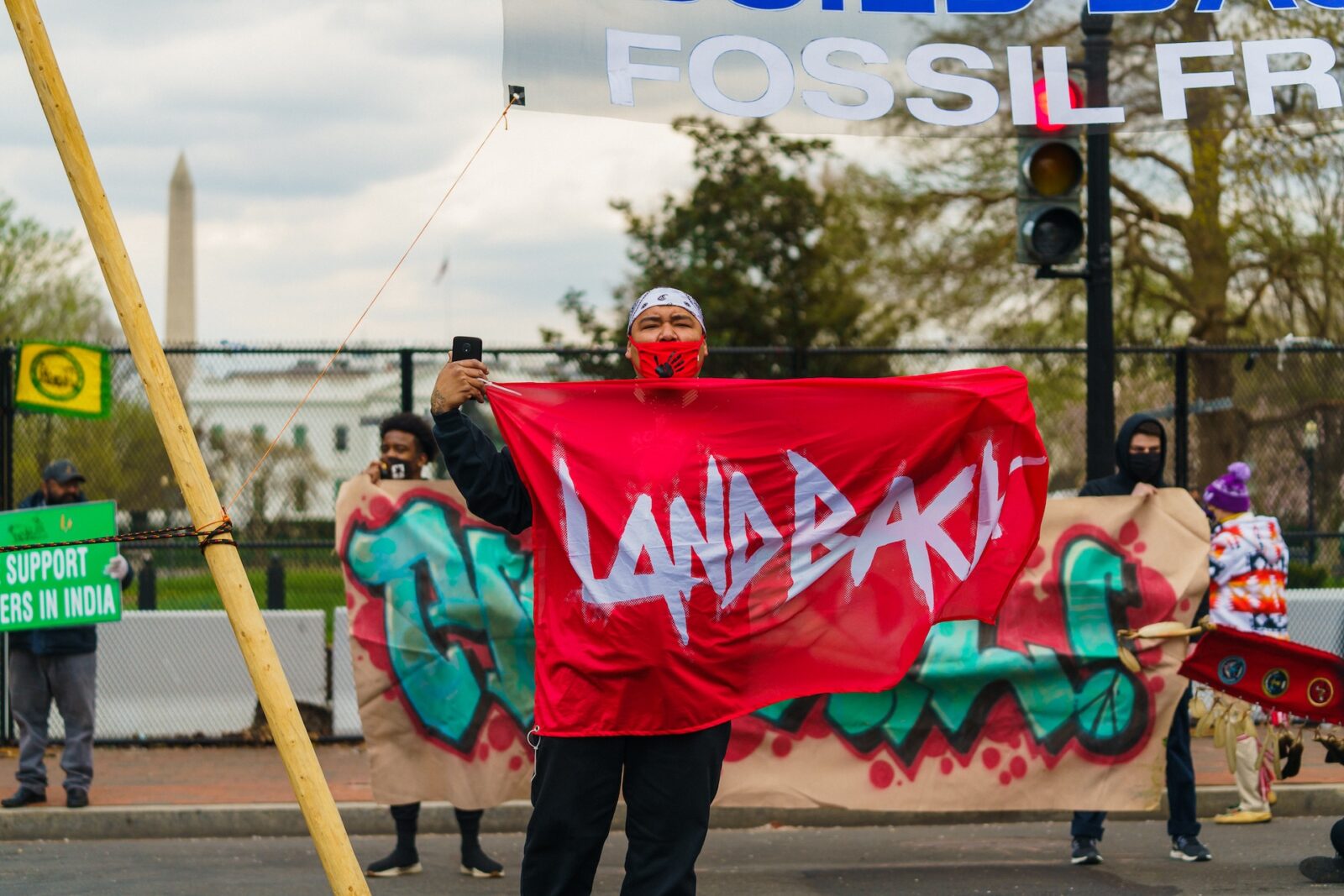
Davis Price: The United States has failed to uphold the principles that it learned from Indigenous examples, and it has failed to uphold its own promises. The promise of equality has never been the actual goal of the elites who have controlled American government from its inception. It has been through unrelenting organizing, struggle, and war that American democracy has expanded. However, it is clear that this expansion still falls short, and the gains achieved cannot be taken for granted, as there are forces always trying to whittle away the rights and disenfranchise our most marginalized communities. We must continue to organize and fight for a democracy that includes ALL of us and recognizes the harms of the past to achieve a prosperous future for ALL of us. That includes LandBack for Indigenous peoples.
What do you think about the sentiment that since ‘the system’ doesn’t work for the people, we should completely disengage from participating in campaigns and elections? What is your take on this dilemma?
Dr. Valeriah Big Eagle: The system has often failed Indigenous people, and skepticism is justified, but I don’t believe disengagement has to be the answer. We can participate without putting all our faith in the system. We can vote when it serves our communities, organize outside electoral politics, hold leaders accountable, and continue building our own systems and sovereignty. To me, the answer is not choosing between voting and resistance—we need both.
This is supposed to be a free society, and in a free society, if the government will not allow it to be free, then the people must make it free. There is nothing wrong in criticizing the President of the United States or their illegal law, their gangster law enforcement agencies. There is nothing wrong to stand up and protest against this. They will call us unpatriotic or they will call us militant, they will call us radical or communist. We are the Indigenous People of the Western Hemisphere.
John Trudell, Longest Walk, Pueblo Rally Speech, 1978
Eva Cardenas: As this colonial experiment “celebrates” 250 years, it continues to assert the same harmful practices of possession and dominance through violence against all Relations and Peoples under the guise of democracy and progress. We are active witnesses to the consequences of such contractions that this hollow democracy has created – the ever-rising cost of survival; the destruction and exploitation of land, air, water, and life as we live through the mass extinction of our relatives, accelerated for the profit of a few. So, I understand why people feel let down by these systems. We are. These systems are working as designed, and they were not designed to work for us. To me, disengagement is a valid reaction. And, we do not seek to be reactionary; we seek to be intentional. We must remember and recognize the long-standing legacy of our People’s Resistance, an ancestral fire, to which we have a collective responsibility to keep fed and alive. We must continue to organize, educate, and agitate in all spheres. We must use that fire to light the way towards our collective vision of liberation by any means necessary.
Davis Price: It’s completely reasonable for people to feel frustrated while being disenfranchised and to feel like their voices do not matter. But I donʻt think that disengaging at an individual level is the answer. We need to fight. We need organizations with capacity to reach these individuals and their communities and build platforms for their voices and their issues to be relevant in the political process. We have strength in numbers but only if we are organized. That means we need people to vote, yes, but we also need to build infrastructure across our communities that helps influence candidates running for office to support our positions on critical issues, helps folks know who to vote for, and helps amplify our communities’ issues in political races.’
This is Just the Beginning of a Conversation
We don’t believe voting is sacred, but many sacred places can be affected by our vote. If voting is a tactic instead of the only tactic to build power, then we are going to defend our right as Indigenous Peoples to vote. The bottom line is that we get to choose.
This is why during the 2026 election cycle, we are focusing on developing resources that help our Indigenous communities protect and leverage their right to vote. NDN Collective will publish an Indigenous Voter Guide that informs people how to defend their right to vote and a candidate questionnaire to help individuals more effectively utilize electoral pressure on their candidates to commit to supporting Indigenous needs and solutions.
We hope these reflections are just the beginning of an ongoing conversation to sharpen our collective political analysis of the role of voting in the fight for Indigenous self-determination. As we fight for our liberation, we want to use every tool at our disposal because the stakes are so incredibly high.
We know that voting is not just a logistical and material issue – for many, it’s an emotional one, too. That is exactly why we believe it is so important to acknowledge and talk about these complicated feelings around voting. This is just the start of this discussion, and we want to hear from you: what topics would you like to see discussed? What questions do you have around voting and elections?
Share your questions & thoughts with us to keep this conversation going!